HOME > STAKEHOLDER MANAGEMENT
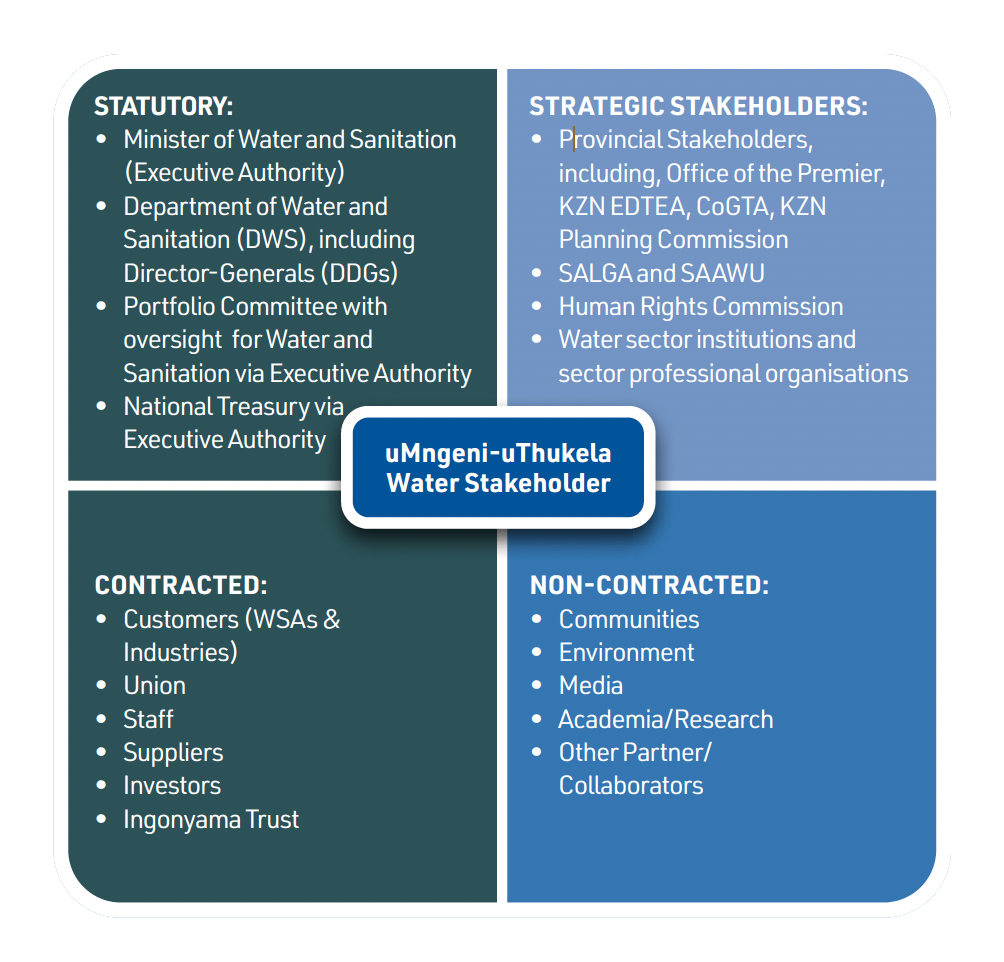
A key Strategic Objective of uMngeni-uThukela Water is to increase customer and stakeholder value, understanding and support, as well as ensure that relationships developed remain constructive. In order to achieve this, structured and regular engagements with stakeholders take place consistently. Stakeholder engagements are undertaken by uMngeniuThukela Water’s Board, management and officials, and these occur with individuals and organisations that are impacted, affected or may have an interest in the core functions of the organisation. As a reflection of the seriousness with which uMngeni-uThukela Water regards stakeholder engagement and cordial relations, stakeholders have been categorised into four groups. These groups are: Statutory, Strategic, Contracted and Non-Contracted. Some engagements are mandatory as they are requirements of the Water Services Act, Act No 108 of 1997 , the Municipal Finance Management Act 56 of 2003 and contractual obligations as per bulk supply agreements with municipal customers.
Engagements with stakeholders on crucial issues
During the financial year under review, uMngeni-uThukela Water strived to maintain the cordial relations it enjoys with all stakeholders. At a Board level, engagements were led by Board Cluster Champions, with support from the Executive Management. Some engagements were championed at the level of the Minister and Deputy Ministers of Water and Sanitation, especially those that required mass public participation or to launch water infrastructure projects. These engagements culminated in robust discussions and resolutions being taken on how to improve bulk water provision or plans to develop potable water infrastructure in instances where such was lacking.
Ministerial interventions
The Board and Executives of uMngeni-uThukela Water participated in a number of community outreach programmes which were led by the Minister and Deputy Ministers of Water and Sanitation. These were geared towards either inspecting progress on the implementation of infrastructure projects, updating communities and stakeholders on progress on implementation or issuing directives to uMngeni-uThukela Water to undertake emergency or long term relief efforts towards water provision.
Some of the engagements and oversight visits took place as follows:
uMngeni-uThukela Water’s other pre-arranged engagements continued with other stakeholders during the period under review. These included meetings with the Office of the Public Protector; Ingonyama Trust Board; other municipal customers of uMngeni-uThukela Water; the Department of Water and Sanitation; and, the the Trans-Caledon Tunnel Authority (TCTA). Numerous strategic focus areas were discussed during these engagements, including;
Engagements also took place with all WSAs and customers of uMngeni-uThukela Water within its area of supply to discuss water provision, progress on infrastructure implementation and the process of mediation over municipal outstanding debt for services provided by uMngeni-uThukela Water.
In the year under review, a Joint Operations Committee on Water Curtailments was established by DWS and UUW. This committee had monthly engagement meetings with eThekwini, Msunduzi and the uMgungundlovu Districts to discuss measures to decrease water consumption in line with curtailment volumes.
All statutory documents for the reporting year were submitted as per deadlines.
Key Areas of Discussions with Stakeholders
A large number of customer engagements took place, including strategic and operational meetings. Engagements with uMngeni-uThukela Water’s customers focused on performance with respect to bulk supply agreements, service delivery needs, infrastructure development, status of water resources, water curtailment, outstanding debt repayments, and, water conservation and demand management. Events that were either hosted by uMngeni-uThukela Water or in which the entity participated were:
uMngeni-uThukela Water is aware of the importance of maintaining a healthy internal pulse. In this regard, engagements took place with employees and the organised labour formation, represented by the National Education, Health and Allied Workers’ Union and the South African Municipal Workers Union.
This included visits to sites to interact with staff members, commemoration of special days in the year, induction of new employees and communiqués designed to inform employees of events, Ministerial and Board announcements and speeches.